Archive for the 'essay' Category

May 31 2008

Something about the I Ching

Fortune Telling 000

The arrangement and interpretations of the I Ching’s hexagrams can be attributed to the astute analysis of human nature in many contexts by many contributors over many years. It’s much more difficult to account for the uncanny accuracy, reasonableness, and wisdom of the I Ching’s answers to one’s questions. That, at least, has been my experience.

The I Ching is the ancient Chinese book that accreted around a series of 64 hexagrams. A hexagram, in turn, is an arrangement of six lines. Each line is either solid or broken. Here are the first two hexagrams, the Creative and the Receptive:

Hexagram 1, the Creative          Hexagram 2, the Receptive

Hexagrams are formed by chance action (e.g., the rolling of three coins, and taking combinations of heads and tails for either a solid or broken line) from the bottom up. The lines are taken to represent a temporal sequence, the unfolding of change over time.

Lines themselves can change, and a changing line is indicated by chance action, as in the roll of three heads (a changing broken or yin line) or three tails (a changing solid or yang line). In the above example, if one tossed a set of three coins six times—once for each line in the Creative—and each roll came up three tails, each line would change into its opposite. The result would be two hexagrams: hexagram one, the Creative, would change to hexagram two, the Receptive.

The odds against a six-in-a-row coin toss are astronomical. But, then, what are the odds in favor of receiving a response that strikes one as both wise and a propos to the question?

Questions. Where do they come from? You, me, worrying the hems of our lives; John Cage, wondering what it really means to compose; and anybody, really, who engages in the act of breasting change with a story of self in mind. To put the previous question another way, What are the odds of a story emerging from apparently unconnected facts, experiences or observations?

As with most fortune telling systems, the odds favor making sense—if you can accept enigmatic replies as sense. For me, the difference between the I Ching and, say, the tarot (which has much sexier images), is perceptual: the I Ching responds in poetry, the tarot in cliché. One enlightens me, the other makes me vomit. It’s not the tarot’s fault; it’s cultural chance. The Romany, vectors of prognostication by chance action of card dealing, eschewed written language until relatively recent times (and then a palette of languages pattern Romany texts, rather than a national language); the Chinese, just as ancient, famously co-pioneered written language. The Romany poetry of the tarot is, at best, confined to a small group of disrespected people while the written texts of the Chinese have become venerated for their wisdom and verisimilitude. Continue Reading »

16 responses so far

Aug 05 2007

A Change in the Weather

Jeanette Winterson, the British novelist, wonders in the Times of London (and which I found via BroneteBlog):

As the floodwaters rose around me and we sank in a summer of rain, I tried a kind of homeopathic charm; what books could I find on my shelves where floods and rain played a part?

Multiple lightning strikes; image: NOAAWinterson rattles off the usual list of suspects, including the biblical flood story and (weirdly) the movie version of Frankenstein (which movie? and why not the novel?). What’s odd to me is that almost none of the academic eco-criticism types have picked up on climate as at least a viable leit motif for analysis. In my reading of gothic lit, climate and weather are veritable characters. Wouldn’t it be useful (something that is normally very difficult to say about contemporary literary studies) to analyze climate and weather in literature with an eye toward shedding some light on our current crisis, a crisis which, in our inability to do anything concrete about, is surely as much moral and psychological as scientific and economic?
I took a stab at it a couple years ago by presenting a paper at a low-level, regional MLA lit-studies conference. I was met with blank stares, for the most part, perhaps because I eschewed the jargon of the trade as much as possible. Because they could understand all the words I used, the audience may have felt talked down to. Or maybe it’s just a crappy paper. It certainly doesn’t delve deep enough into the implied thesis: that climate is a character or anyway a means of characterizing roles.

In any case, here’s the paper as presented at the conference in 2005. Perhaps it’ll be of some use to an eco-conscious scholar attempting to open the field of climatocriticism. Continue Reading »

No responses yet

Apr 19 2007

Peter Gelman Podcasts

Published by Brian under mp3, essay, fiction

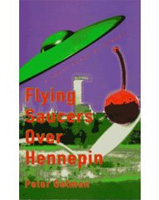
Click to buy Pete's novel, Flying Saucers Over HennepinOne of my favorite writers, Peter Gelman, is up to his old tricks. He’s done up some real nice podcasts, including one of his novel “Skull of the Robot.” Pete’s also a bicycle activist with a wry and dry (and possibly extra-planetary) sense of humor, so don’t miss “Mysteries of the Bicycle Explained.” Pete’s site, Danger Quest Mysteries, has more juicy goodness, so check it out, ‘k?

Long-time Permeable Press fans will remember Pete as the author of “Flying Saucers Over Hennepin” which Paul di Filippo, writing in Asimov’s Science Fiction Magazine, described thusly: “Serious frivolity is in short supply today … Gelman spins a hilarious tale that addresses crucial dilemmas of our modern existence via a rubber chicken upside the head.”

No responses yet

Apr 04 2007

Memories from Life after Death (for RAW and T. McK.)

Essay by Brian Charles Clark

As Robert Anton Wilson (the man, the modality, the moonmeld) indicated in undisclosed locations known only to a select few, and the Dogon of West Africa have known for thousands of years, cheese is of alien origin. The phrase “the moon is made of green cheese” is not just smoke blowing from the door of an opium den. Rather, it is a literal truth, one a world-wide conspiracy has sought to suppress for many moons. Cows are robots from space, implanted with soulful stares that have but one purpose: to disarm and befuddle the planet Earth’s population into thinking that they, and other udder-bearing beasts, are the sole source of milk and milk by-products. Which, in fact, they are. Continue Reading »

One response so far

Jul 17 2005

Ezra Pound

Published by Brian under philosophy, essay, poetry, reviews

review by Brian Charles Clark

Ezra Pound: Early Writings
edited by Ira B. Nadel
Publisher: Penguin, 2005

Ezra Pound, Early WritingsEzra Pound was the godfather of the modernists. James Joyce, the reigning Titan, said that “Nothing could be more true than to say we all owe a great deal to” Pound: “I most of all.” Unlike T.S. Elliot, who is better remembered for his poetry than his criticism, it was Pound’s critical faculties that made him such a seminal influence among his peers. Like some omnipresent deity from Olympus (apparently a mountain near Pound’s birthplace in Hailey, Idaho), he had his fingers in everything and everybody’s business as a kind of jovial dictator and boss vivant.

Collected here are some of the early works of the mature Pound. No juvenilia sullies the mix of poetry and prose. As a poet Pound was always interested in translation—from the Anglo-Saxon, the Chinese, and other languages—and the surprising discord and serendipitous harmonies to be heard when poetry crosses borders. So here we get Pound’s wonderful “Seafarer,” one of the oldest poems in the English language, rendered in modernist (if not exactly “modern”) English, and “Liu Ch’e,” “a wet leaf that clings to the threshold” separating the placid, nature-loving philosophy of Chinese poetry and the speed-obsessed futurism of the early twentieth century. Continue Reading »

No responses yet

Feb 28 2005

Enclosing the Creative Commons

review by Brian Charles Clark

Freedom of Expression
by Kembrew McLeod
Publisher: Doubleday, 2005

No Trespassing
by Eva Hemmungs Wirtén
Publisher: U. Toronto Press, 2005

Freedom of ExpressionIn recent decades intellectual property (IP) law has become the handmaiden of transnational capitalism. “Fair use”, at least in the United States, has become a hollow shell: tap it and it shatters into a thousand sharp-edged lawsuits. Two recent books delve into the history of and effects on creativity resulting from globalized IP law. The overall picture for scientists and artists in all media is gloomy. As novelist Michael Chabon concluded, in a recent review-essay on the sources of Conan Doyle’s Sherlock Holmes stories, “Every novel is a sequel. Influence is bliss.” Influence is bliss indeed, at least until it falls under the boot heel of regressive capitalism. Now royalties, licensing fees and corporate secrecy make creative ‘gene swapping’ too expensive for most artists and scientists.

“Follow the money” is the credo of investigative journalists. As Eva Hemmungs Wirtén argues in No Trespassing, it’s also the logic of empire when scoping out the landscape of IP law in general, and copyright law in particular. No Trespassing is tightly focused on book culture: the rise of copyright law in Western Europe and the U.S., the role of translation in commodifying authorship, and the blood-drawing lawsuits that result from the bliss of influence and the influence of technology (the photocopier in particular). Wirtén’s book, with its tight focus, deep historical view, and thorough-going scholarship make it a well-written complement to McLeod’s more free-wheeling Freedom of Expression. Continue Reading »

One response so far

Oct 31 2002

Trust Fall

Published by Brian under memoir, essay

Essay by Brian Charles Clark

I always fall in love with the girl in the book. When I was five, I fell in love with Sal, in Blueberries for Sal. She filled her pail with berries and then ate them all, saving none for later. That’s the sort of self-indulgence I can identify with.

When I was twelve, my biblioamour was Eowin, the warrior princess in Tolkien’s Lord of the Rings. Eowin dressed up like a boy in order to escape the confines of her gender, so that she could go out and fight the good fight. Later it was voices on the radio, like when I was ten and fell hard for Melanie. That was around 1968, and when she belted out a chorus to, “Candles in the Rain,” I understood why people sometimes said, “I’d lay my life on the line”—for her, to protest the War, to ensure that we can each love whom and when we want. At about that same time I came to the realization that love can’t be restricted, at least not the way that, say, grammar can be prescripted. If the culture I was born into seemed to insist that boys fall in love with girls, I was certain, at nine or ten, that this must be some sort of misunderstanding. Continue Reading »

No responses yet

Feb 14 2002

A Tapestry of Metaphor

Published by Brian under linguistics, essay, poetry

Essay by Brian Charles Clark

In this essay I speculate on a possible relationship between “word,” “writing,” “weaving,” and “work.” While the essay is speculative in its etymology, I think it does show a definite intertwining of the histories of metaphors that underpin the changes in meaning we see from Indo-European, Greek, and Latin, into English. Because of limited space, my investigation into the histories of these words is of need cursory. My intent here is to entertain and provoke the reader’s own imaginative speculations, not to create a definitive history or an airtight case.

A *wer is a “high raised spot” (American Heritage Dictionary, wer1). I can imagine a letter or word carved in stone or wood being called a “high raised spot.” *Wer (ibid., wer3) also means “to turn, bend.” From this root we get our Germanic “worth,” because value is a turning toward fair exchange, and Latinate “verse,” the fruits of the poet’s turns of phrase. In olden times, a traveler was worth his board based on the value of his conversation. And everybody knows the value of the devil’s silver tongue, whose conversation can pivot on a dime, and suddenly turn to your soul’s worth. Continue Reading »

One response so far

Jan 23 2002

River Run Requiem

Published by Brian under memoir, essay

Essay

by Brian Charles Clark

Since his death I’ve been trying to discover who killed my brother.

Is it a crime to kill a man who longs for death? If a man yearns for death so profoundly that he kills himself, has he committed a crime, broken the taboo? I still ask Chris these questions, although he’s been dead for nearly three years now.

Of his death, there is only one fact, and this fact contradicts itself. Christopher Michael Clark, aged 37 years, drowned in the Mojave Desert on August 15, 1997. An amazing feat in an accident-prone life, to drown in the middle of the desert. He found the thing he went to find. Death, I see, is as subjective and unknowable as any other experience. Time is relative, Einstein reminds me, and space is curved. Continue Reading »

One response so far

Dec 19 2001

Marvell’s “The Garden”

Published by Brian under essay, poetry

I’ve heard it said, or maybe I read it somewhere, that travel is good therapy for an ailing marriage. There’s something romantic about leaving jobs, kids, and friends behind and going to some place where it’s “just us two.” “A romantic paradise,” the travel agency ads claim about almost anywhere. Travel strips us down to our ontic necessities—which is why some people don’t travel well: they need everything. For those who can get by on a toothbrush and a change of underwear, any cheap motel room can become a “bower of bliss,” an erotic Eden. Add a loaf of bread and a bottle of wine and even St. Paul would have a difficult time getting the couple to listen. Continue Reading »

No responses yet

Next »

Close
E-mail It